
Introduction: When Poor Storage Starts Costing You Money
Picture this: your warehouse team spends 20 minutes locating a single pallet. Your retail shelves are half-empty by mid-afternoon. Your stockroom is a floor-to-ceiling maze of unstacked boxes that nobody dares touch. These are not isolated frustrations — they are measurable operational losses compounding daily.
According to research by the Warehousing Education and Research Council, inefficient warehouse storage directly reduces operational productivity by up to 30%. For logistics businesses, that translates to delayed shipments and client attrition. For retailers, it means lost sales from unavailable stock. For manufacturers, it creates production line interruptions that ripple across the entire supply chain.
The solution starts with the floor plan and ends with the right racking system. Choosing the correct warehouse storage racks — matched to your product type, facility dimensions, handling equipment, and growth projections — is one of the most high-impact infrastructure decisions any operations manager can make. This guide explains exactly how to do it, drawing on industry data and the expertise of Murphy Racks, a specialist manufacturer of industrial storage racks, supermarket racks, pallet racking systems, and custom retail shelving.
Warehouse & Logistics Industry Insights: The Numbers That Matter
Warehouse & Logistics Industry — Key Statistics
- Inefficient warehouse storage reduces operational productivity by up to 30%. (Warehousing Education and Research Council)
- The global warehouse racking market is projected to grow from USD 10.2 billion in 2023 to USD 16.8 billion by 2030. (Grand View Research)
- Businesses that implement structured vertical storage systems increase usable floor space by an average of 40–50%. (MHI — Material Handling Institute)
- Poor inventory organisation is cited as the leading cause of order fulfilment errors in 47% of warehouses. (Zebra Technologies Warehouse Vision Study)
- Retailers lose an estimated 4% of annual revenue to out-of-stock situations caused by poor shelf management. (IHL Group)
- E-commerce warehouse demand has grown by over 150% in the past five years, intensifying pressure on efficient storage solutions. (CBRE Logistics Report)
- Structured rack systems can reduce product damage during storage by up to 25% compared to floor-stacking methods. (Health & Safety Executive, UK)
Business Storage Problems: What Happens Without the Right Rack System
Before exploring solutions, it’s worth understanding the specific operational challenges that the right warehouse shelving system is designed to solve.
- Limited Floor Space and Wasted Vertical Height
Most warehouses use less than 30% of their available vertical space (MHI). The result is a facility that feels permanently overcrowded at ground level while metres of unused air space sit above. Vertical racking systems — from pallet racks to mezzanine structures — convert that air space into productive storage, often doubling or tripling effective capacity without expanding the building footprint.
- Inefficient Inventory Access and Picking Errors
When goods are stacked on floors or stored without a structured system, finding specific items becomes a time-consuming exercise that directly erodes warehouse organization. Order picking accuracy suffers. Staff spend time searching rather than fulfilling. Industrial shelving systems with clearly designated locations for every SKU eliminate this friction.
- Poor Product Visibility in Retail Environments
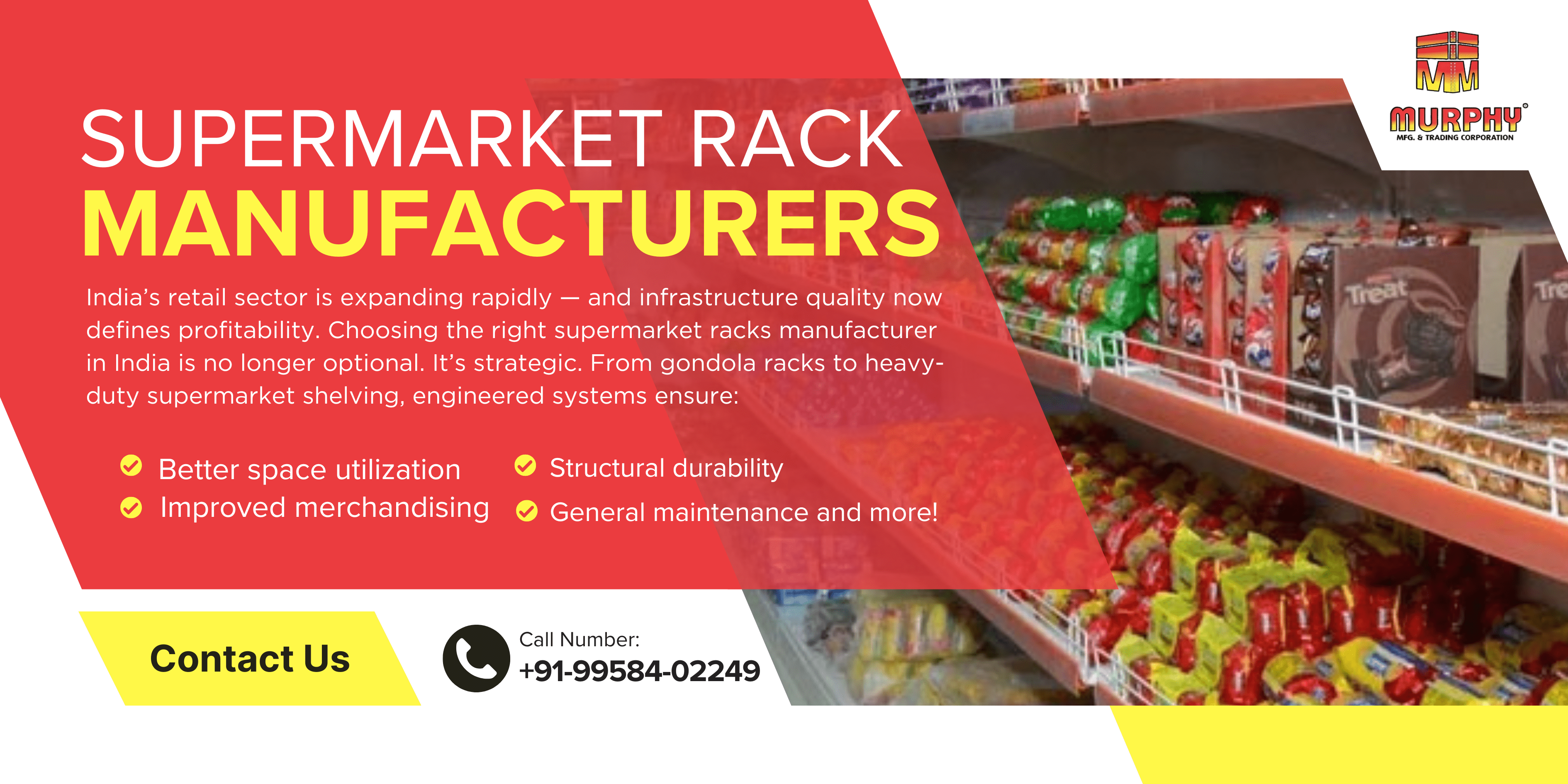
In supermarkets and retail stores, product visibility drives purchase decisions. Items that are poorly displayed, inaccessible, or undersupplied on shelves lose sales directly to competitors. Gondola racks and purpose-designed retail display racks maximise product facing, reduce restocking time, and create a shopping environment that encourages browsing and impulse purchase.
- Slow Stock Movement and Inventory Obsolescence
Without a structured warehouse rack system that supports FIFO (First In, First Out) stock rotation, products — particularly perishables, pharmaceuticals, and date-coded goods — can expire before reaching the customer. The right racking configuration, combined with clear labelling and access protocols, enforces FIFO naturally.
- Safety Risks from Improper Storage
Floor stacking beyond safe heights, overloaded shelving, and blocked emergency access routes are not just operational problems — they are liability exposures. A collapsed rack or toppled stack causes injury, damages stock, disrupts operations, and triggers regulatory scrutiny. Purpose-built heavy duty warehouse racks with rated load capacities eliminate the guesswork from safe storage.
What Are Warehouse Storage Racks?
✦ Featured Snippet Answer Warehouse storage racks are engineered metal frameworks designed to store goods, pallets, or retail products in an organised, space-efficient, and accessible manner. They come in multiple configurations — from heavy-duty pallet racks and industrial shelving to retail gondola systems — and are selected based on load requirements, product type, facility dimensions, and handling methods. |
At their most fundamental level, warehouse storage racks solve one universal problem: how to store more, access it faster, and do it safely. The variety of rack systems available today reflects the diversity of storage challenges across industries — from a 20,000 sq ft FMCG distribution centre to a 500 sq ft pharmacy stockroom.
Murphy Racks manufactures the full spectrum: from structural pallet racking systems designed for forklift operations to lightweight slotted angle racks for office stores, and bespoke supermarket racks engineered for high-volume retail environments. The right system depends on understanding each product category in detail.
Types of Warehouse Rack Systems: A Complete Product Guide
- Pallet Racking Systems
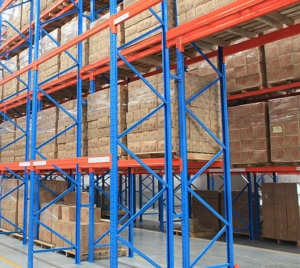
The workhorse of heavy logistics and distribution. Pallet racking systems consist of vertical upright frames connected by horizontal load beams, creating palletised storage levels accessible by forklift or reach truck. They are the most capacity-efficient solution for any facility storing palletised goods at volume.
- Best for: Distribution centres, FMCG warehouses, cold storage, 3PL operations
- Variants: Selective pallet racking (standard), drive-in racking, push-back racking, narrow aisle racking
- Load capacity: Typically 1,000 – 5,000 kg per pallet level depending on configuration
- Key advantage: Maximum vertical height utilisation; full pallet access at every level
- Heavy-Duty Storage Racks
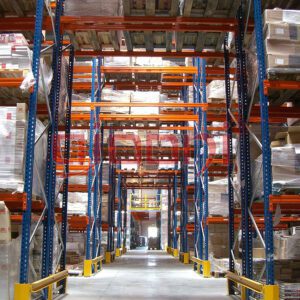
Engineered for industrial environments where individual items or part-loads are heavy, bulky, or irregularly shaped. Heavy duty warehouse racks provide robust, multi-tier storage for automotive parts, engineering components, hardware, and manufacturing materials.
- Best for: Manufacturing plants, engineering stores, auto parts, industrial distributors
- Variants: Boltless shelving, rivet shelving, structural steel shelving
- Load capacity: 500 kg – 2,000 kg per shelf level
- Key advantage: High-density storage with manual pick access at all levels
- Slotted Angle Racks
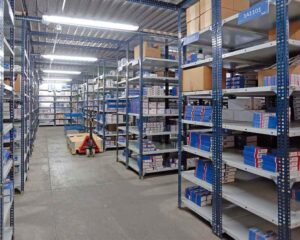
One of the most versatile and cost-effective warehouse shelving solutions available. Slotted angle racks use a simple cross-braced, bolt-together design that is infinitely adjustable and suitable for a wide range of applications — from light stores to medium-density warehousing.
- Best for: Offices, small warehouses, retail stockrooms, spare parts stores
- Load capacity: 100 – 500 kg per shelf
- Key advantage: Fast assembly, fully adjustable, low cost, highly portable
- Supermarket & Gondola Racks
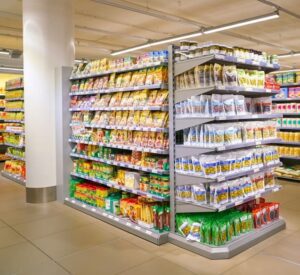
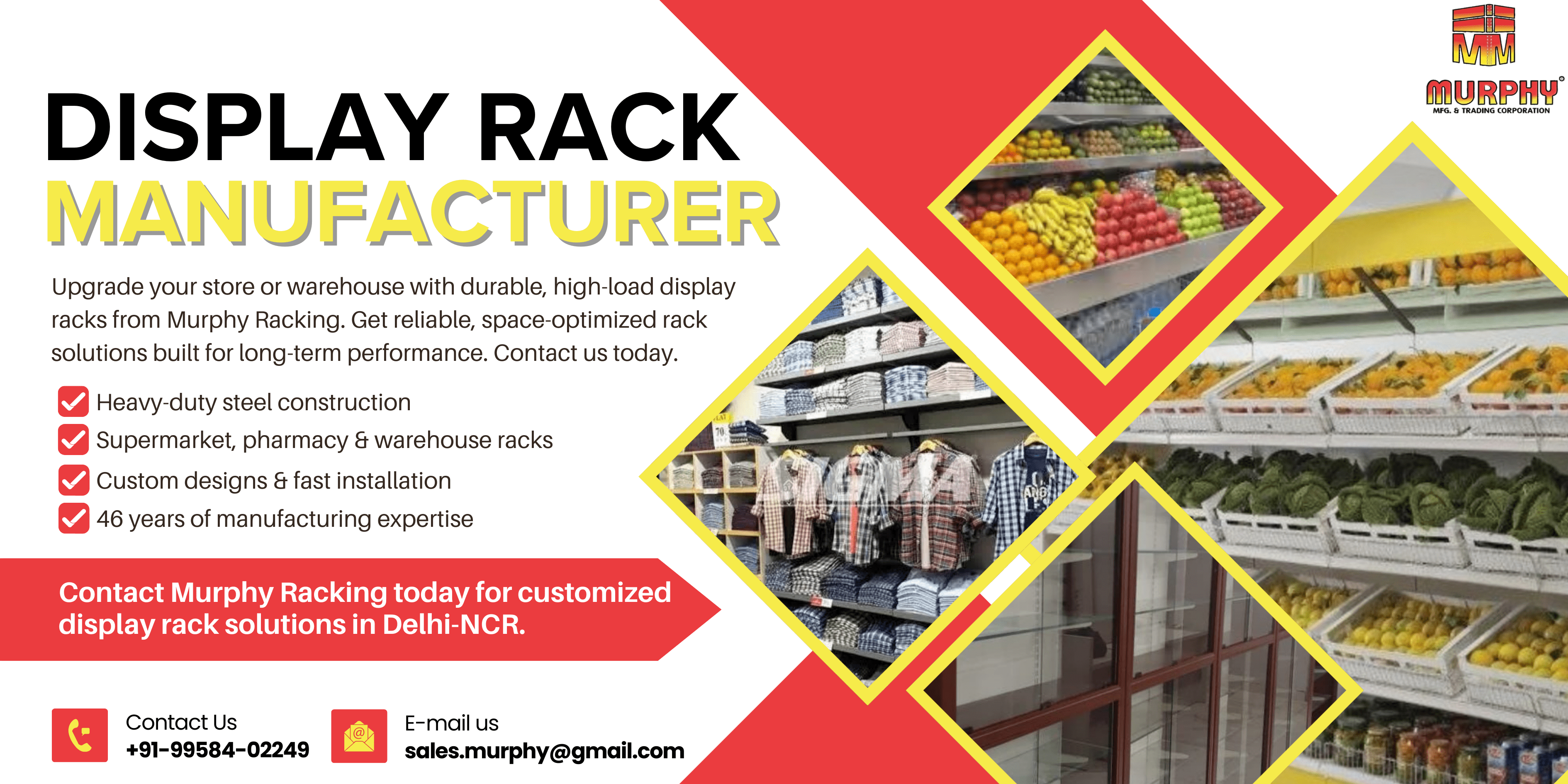
Designed specifically for retail environments, supermarket racks and gondola units are freestanding, double-sided shelving systems that create organised retail aisles with maximum product visibility. Murphy Racks is a specialist supermarket racks manufacturer with extensive experience in retail chain fit-outs.
- Best for: Supermarkets, FMCG retailers, pharmacies, convenience stores
- Features: Adjustable shelves, end-cap display panels, price track channels, hanging accessories
- Key advantage: Maximises product facing and impulse purchase opportunity per square metre
- Retail Display Racks
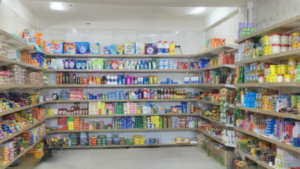
Purpose-designed for high-visibility product presentation in showrooms, clothing retailers, electronics stores, and branded retail environments. Retail display racks balance aesthetic design with functional storage, supporting product launch displays, seasonal promotions, and permanent category fixtures.
- Best for: Fashion retail, electronics, cosmetics, branded showrooms
- Variants: Wall-mounted fixtures, free-standing display units, island units, tiered display stands
- Key advantage: Enhances brand perception while maximising sales floor product density
- Mezzanine Rack Systems
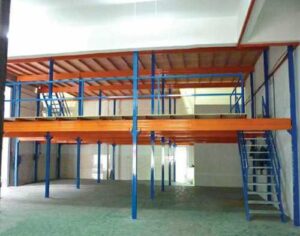
Where ceiling height allows, mezzanine racking systems create a second — or even third — floor of storage within an existing warehouse without structural building work. This is one of the highest-ROI storage investments available to businesses facing space constraints.
- Best for: E-commerce fulfilment, high-value goods, archive storage, pick-and-pack operations
- Load capacity: Structural — typically 300+ kg per m²
- Key advantage: Can double usable floor area without increasing building footprint or lease cost
Comparison: Warehouse Rack Types at a Glance
Rack Type | Best For | Load Capacity | Space Efficiency | Typical Industries |
|---|---|---|---|---|
Pallet Racking System | Bulk pallet storage | Up to 5,000 kg/level | Very High — full vertical use | Logistics, manufacturing, FMCG |
Heavy-Duty Storage Racks | Large, heavy items | 500 kg – 2,000 kg/shelf | High — multi-tier options | Industrial plants, auto parts |
Slotted Angle Racks | Medium-weight goods, flexibility | 100 – 500 kg/shelf | Medium — adjustable heights | Offices, small warehouses |
Supermarket / Gondola Racks | Retail product display | 50 – 200 kg/shelf | High — double-sided display | Supermarkets, FMCG retail |
Retail Display Racks | Consumer product presentation | 30 – 150 kg/shelf | Medium — aesthetic-focused | Retail, showrooms, pharmacies |
Mezzanine Rack Systems | Multi-level floor space creation | Structural — 300+ kg/m² | Extremely High — doubles floor | E-commerce, large warehouses |
Cantilever Racks | Long, irregular items | Up to 3,000 kg | High for irregular stock | Timber, steel, furniture trade |
The right rack type is always determined by a combination of load requirements, handling method, product dimensions, and operational workflow — not by price alone.
How to Choose the Right Warehouse Rack System: A Buyer's Decision Guide
Selecting the wrong warehouse rack system is an expensive mistake — both to install and to correct. Here is a structured decision framework used by Murphy Racks consultants during every facility assessment:
- Define your product profile — What are you storing? Dimensions, weight per unit, packaging type (palletised, boxed, loose)? This determines the fundamental structural requirements of your rack system.
- Map your facility dimensions — Measure usable floor area, ceiling height to underside of beam or sprinkler head, column positions, and door/loading bay locations. Every dimension affects rack placement and aisle configuration.
- Identify your handling method — Forklift, reach truck, manual picking, or a combination? Forklift-accessed systems require wider aisles. Manual systems can be denser. The handling method determines aisle width and rack depth.
- Calculate your storage volume — How many SKUs? How many pallets or shelf positions? What is your projected growth over three to five years? Over-spec slightly to avoid costly expansion within two years of installation.
- Assess your throughput frequency — High-frequency picking operations need selective rack systems with easy access to every position. Lower-frequency bulk storage can use higher-density configurations like drive-in or push-back racking.
- Set a realistic budget — including installation — Material cost is only part of the total investment. Include installation labour, floor anchoring, safety accessories (rack guards, column protectors, safety netting), and signage.
- Request a facility assessment — Murphy Racks provides on-site consultations and 2D/3D layout design services to ensure the proposed system maximises your specific facility’s storage potential before any commitment is made.
Warehouse Storage Optimisation: Getting More From Your Facility
- Maximise Vertical Space
Most warehouses are designed with 6–12 metre ceiling heights but store goods only to 2–3 metres. Installing warehouse racking systems that reach the full available height — with proper forklift or reach truck access — can increase effective storage capacity by 200–300% within the same floor area.
- Design for Workflow, Not Just Storage
The best rack layout is one that mirrors your picking and despatch workflow. High-frequency items should be stored closest to the despatch area at ergonomic picking height. Bulk reserve stock can occupy upper levels or deep storage positions. Warehouse organization systems designed around workflow reduce travel time per pick — the single largest driver of warehouse labour cost.
- Use Zone-Based Inventory Organisation
Divide your warehouse into logical zones: bulk storage, active pick, fast-movers, returns, and despatch staging. Each zone requires different warehouse shelving solutions — bulk zones benefit from pallet racking; active pick zones suit boltless shelving; fast-mover zones may need flow rack or carton live storage systems.
- Implement Clear Labelling and Location Codes
A rack system without a labelling system is a storage system without a memory. Every rack bay, level, and position should carry a unique location code that maps directly to your warehouse management system (WMS). This enables accurate directed putaway, pick confirmation, and stock audit — reducing errors by up to 40% (Zebra Technologies).
- Plan for Seasonal and Growth Flexibility
Murphy Racks designs all systems with adjustment and expansion in mind. Slotted angle and boltless systems can be reconfigured quickly. Pallet racking can be extended bay-by-bay as volume grows. Building flexibility into your initial design prevents the need for complete system replacement when your business scales.
Mini Case Study: How a Logistics Company Increased Storage Capacity by 80%
“We were operating at what we thought was full capacity — but we were only using the bottom 3 metres of an 8-metre warehouse. Murphy Racks designed a narrow aisle pallet racking layout that transformed the facility. We didn’t need a larger warehouse. We just needed the right racking.” — Operations Director, Logistics & Distribution Company, India |
A mid-sized logistics company operating a 15,000 sq ft warehouse in Maharashtra had reached what they believed was maximum storage capacity. They were evaluating a costly lease expansion when they approached Murphy Racks for a facility assessment.
The Murphy Racks team identified that the facility was using only 35% of its available vertical height. A redesigned storage layout using narrow aisle selective pallet racking and a battery-powered reach truck programme was proposed:
- Pallet racking installed to 7.5 metres — increasing effective pallet positions from 480 to 864 within the same floor area.
- Aisle width reduced from 4.2m to 2.4m using narrow aisle racking — freeing 1,800 sq ft of additional floor for staging and despatch.
- Zone-based inventory layout implemented — fast-moving SKUs positioned at ground-floor pick level, reserve stock elevated.
- Location labelling and WMS integration completed — pick accuracy improved from 94.2% to 99.1% within three months.
Total storage capacity increased by 80%. The lease expansion was cancelled, saving the business an estimated ₹28 lakhs per year in additional rent. Full return on the racking investment was achieved in under 14 months.
Common Warehouse Storage Mistakes That Cost Businesses Money
⚠ Common Warehouse Storage Mistakes to Avoid
|
Future Trends in Warehouse Storage and Industrial Racking (2025 and Beyond)
- Automated Storage and Retrieval Systems (AS/RS)
Robotic picking systems and automated vertical carousels are transforming high-density warehousing. The rack systems supporting these technologies must be engineered to tighter tolerances and integrated with software systems from the outset. Murphy Racks is developing automation-compatible racking solutions for the next generation of smart warehouses.
- E-Commerce-Driven Micro-Fulfilment Centres
The rapid growth of same-day and next-day delivery is driving demand for compact, high-density storage in urban micro-fulfilment centres. These facilities need rack systems that maximise SKU density in small footprints — driving innovation in mezzanine systems, mobile shelving, and vertical lift modules.
- Sustainable Rack Manufacturing
Procurement specifications increasingly require suppliers to demonstrate environmental credentials. Murphy Racks is investing in recyclable steel rack systems, reduced-waste manufacturing processes, and product take-back programmes that support circular economy principles in industrial infrastructure.
- WMS-Integrated Rack Labelling and IoT Sensors
Smart racking systems with embedded weight sensors, RFID location tracking, and real-time WMS integration are moving from enterprise-only to mid-market accessibility. These technologies reduce inventory errors, enable real-time stock visibility, and support dynamic slotting — placing fast-moving items in optimised positions based on live order data.
- Modular and Rapidly Reconfigurable Systems
Business agility demands storage systems that can be reconfigured without a specialist team. The next generation of warehouse shelving solutions prioritises tool-free assembly, modular extension capability, and component interchangeability — reducing the cost of adapting storage infrastructure to changing inventory profiles.
Conclusion: The Right Rack Is a Revenue Decision
Warehouse storage racks are not an operational afterthought — they are a strategic asset. The right system directly determines how much you can store, how efficiently your team can work, how accurately orders are fulfilled, and how safely your facility operates. Get it right and the ROI is measurable within months. Get it wrong and the costs accumulate invisibly — in lost time, damaged goods, safety incidents, and eventually a costly redesign.
The framework is straightforward: understand your product profile, map your facility, define your handling method, plan for growth, and work with a specialist manufacturer who can design a system optimised for your specific operation — not a generic catalogue solution.
Murphy Racks brings over a decade of industrial racking expertise to every project. From pallet racking systems for large-scale logistics operations to supermarket racks for retail chain fit-outs and custom storage solutions for non-standard facilities, Murphy Racks engineers storage infrastructure that performs from day one — and scales as your business grows.
Get a Custom Storage Solution from Murphy Racks
Murphy Racks is a specialist manufacturer of warehouse storage racks, pallet racking systems, supermarket racks, industrial shelving, and custom storage solutions for businesses across India. Whether you are fitting out a new distribution centre, expanding an existing warehouse, or redesigning a retail store layout, our team provides free facility assessments, custom rack design, and professional installation — end to end. Our B2B clients include logistics companies, supermarket chains, manufacturing businesses, and procurement teams across sectors who rely on Murphy Racks for high-quality, competitively priced storage infrastructure built to last. 👉 Visit murphyracks.com or contact our team today for a free consultation and customised storage solution quotation. |
References & Further Reading
- Warehousing Education and Research Council (WERC) — Warehouse Productivity Benchmarks — werc.org
- Grand View Research — Warehouse Racking Market Report 2023–2030 — grandviewresearch.com
- Material Handling Institute (MHI) — Vertical Storage Efficiency Report — mhi.org
- Zebra Technologies — Warehouse Vision Study 2024 — zebra.com
- IHL Group — Out-of-Stock Retail Revenue Loss Study — ihlservices.com
- CBRE — Global Logistics & Warehouse Real Estate Report 2024 — cbre.com
- Health & Safety Executive (UK) — Warehousing and Storage Safety Guidance — hse.gov.uk
Frequently Asked Questions (FAQ)
Ans: Warehouse storage racks are engineered metal structures designed to organise, store, and provide access to goods in warehouses, retail stores, and industrial facilities. They maximise vertical space, improve inventory accessibility, reduce product damage, and dramatically increase operational efficiency compared to floor-level storage.
Ans: Pallet racking is designed for forklift-accessible storage of palletised goods at height, with each level typically holding full pallets loaded mechanically. Heavy-duty shelving is designed for manual picking of non-palletised goods at lower heights, with higher shelf frequency and more flexible load configurations.
Ans: Load capacity varies significantly by rack type and configuration. Slotted angle racks typically handle 100–500 kg per shelf. Heavy-duty racks support 500–2,000 kg per shelf. Pallet racking systems can carry up to 5,000 kg per pallet level. Always follow manufacturer load ratings and conduct a structural review before exceeding specified limits.
Ans: A pallet racking system consists of upright frames connected by horizontal beams that form load-bearing levels. Pallets of goods are placed on these beam levels using forklifts or reach trucks. The system enables dense vertical storage across a warehouse’s full height, dramatically increasing storage capacity per square metre.
Ans: The right rack system depends on your product type and weight, storage density requirements, available floor area and ceiling height, forklift or manual picking operations, and budget. Murphy Racks offers free facility assessments and custom rack design consultations to help businesses identify the most cost-effective solution.
Ans: Yes. Murphy Racks specialises in custom rack manufacturing for non-standard dimensions, unusual ceiling heights, irregular floor layouts, and specific load requirements. Custom solutions are designed to maximise the storage potential of any facility, regardless of its structural constraints.
Ans: Gondola racks are freestanding, double-sided shelving units widely used in supermarkets, retail stores, and pharmacies. They can be positioned centrally in retail floor space to create aisles and are highly configurable with adjustable shelves, product hooks, price track accessories, and end-cap display panels.
Ans: Conduct regular visual inspections of upright frames, beams, and base plates for dents, bends, or corrosion. Replace damaged components immediately. Ensure rack load labels are visible and respected. Anchor uprights to the floor according to manufacturer guidelines. Train forklift operators in rack proximity awareness.
Ans: Lead times for custom warehouse storage racks depend on the complexity and scale of the project. Murphy Racks works with businesses to provide accurate project timelines during the consultation stage. Standard product ranges are typically available for faster despatch. Contact the Murphy Racks team for a specific timeline.
Ans: Yes. Murphy Racks provides professional rack installation services to ensure all systems are correctly assembled, anchored, and load-rated in accordance with manufacturer specifications and applicable safety standards. Installation by trained professionals also protects your warranty and ensures immediate compliance.